What Code 128 is for
Code 128 is the general-purpose barcode. It is not tied to any registry, so the content is yours to decide. That makes it the right choice any time the barcode only has to work inside your own business or between you and a partner who has agreed the format.
- SKU labels on products, shelves and bins.
- Order and shipment numbers on pick lists and packing slips.
- Asset tags on equipment, tools and returnable containers.
- Amazon FNSKU labels, which are Code 128 under the hood. There is a ready-made FNSKU label generator for those.
- Carrier tracking barcodes, most of which are Code 128 or its GS1 variant.
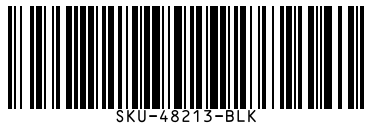
How Code 128 keeps barcodes short
Code 128 has three character sets and switches between them inside one barcode. Set A covers capitals and control characters. Set B covers capitals, lowercase and punctuation. Set C encodes digits in pairs, so two digits take the space of one letter.
This tool chooses the sets for you to produce the shortest barcode. You can use that knowledge when you design your codes:
- A run of four or more digits is cheap.
482130takes three symbols, not six. - An odd number of digits wastes one.
0482130is no wider than482130plus a single character. - Mixing letters and digits one at a time, like
A1B2C3, is the most expensive pattern.
How wide will it be?
Every character adds 11 narrow-bar widths, and the start, check and stop characters add 35 more. At a comfortable print density that works out to roughly:
| Content | Approximate width | Fits on |
|---|---|---|
| 8 letters or 16 digits | 1.4 in (36 mm) | A 2 x 1 in label |
| 12 letters or 24 digits | 1.9 in (48 mm) | A 2.25 x 1.25 in label |
| 20 letters | 2.75 in (70 mm) | A 4 x 2 in label |
These figures include the blank margin at each end and assume a narrow bar of 0.010 inches (10 mil), which every common scanner reads easily. If your code will not fit, shorten the code before you shrink the barcode. The SKU generator builds short, consistent codes from product names.
Code 128 for a whole catalogue
Paste your SKU column into the bulk barcode generator to print every label on standard sheets. If a trading partner has asked for lot numbers or expiry dates in the barcode, they almost certainly mean GS1-128, which is Code 128 with a fixed structure for that data.